
Part 2: 1968–1969 Matra, and the timber yard that won a world championship
There is a neat way of telling Tyrrell’s story that begins with trophies. It is the obvious way, and it is mostly true. But it misses the detail that explains how a small, sharply run organisation became capable of winning at the sport’s highest level, and why it would soon have to reinvent itself.
Tyrrell begins with a yard.
Not the kind that would ever make a press pack. A working timber yard in Surrey, the sort of place you would pass without looking twice. In December 1969, Motor Sport described the Matra International operation’s day-to-day reality with a line that still lands like a dare: “Yet all maintenance and administration has been conducted from the wood-yard at Horsley in Surrey…”. It added that Ken Tyrrell divided his time between the racing team and “his other business life as a round-timber merchant.” The article’s tone is not mocking. It is impressed, almost slightly baffled. It calls it “a measure of his ability as an organiser” that neither business nor racing suffered in “this unusual environment.”
You could write that off as a charming origin story. In fact it is Tyrrell’s operating principle, set in concrete. Tyrrell did not win by looking like it belonged. Tyrrell won by behaving like it belonged, and by making better decisions, sooner, than the people around it.
Motor Sport was direct about that too: Tyrrell, it wrote, had “the innate ability to make the correct decision, and make it at the right time.”
“All maintenance and administration has been conducted from the wood-yard at Horsley in Surrey…”
The yard mattered because it anchored Tyrrell to a kind of realism Formula One often tries to escape. Tyrrell was local to the area, became a timber merchant after the war, and the timber business stayed alongside racing for years. Motor Sport noted that the unusual environment seemed to harm neither pursuit. It is a useful clue to his leadership style: practical, unsentimental, and focused on outcomes rather than theatre.
On the ground, the place sounded almost aggressively ordinary. Motor Sport described “the cinder-strewn yard” surrounded by wooden sheds, with a more substantial brick office where Tyrrell and his small band did the admin, took the calls, and turned an entrant’s operation into something approaching a works team. It is hard to overstate how much that matters to the Tyrrell story. F1 often celebrates genius as inspiration. Tyrrell’s genius was organisation. It was the belief that the unglamorous work is the real advantage.
A works team in a shed.
The late 1960s were a moment when Formula One was splitting into two species. There were still teams that travelled light, fixed things with instinct, and relied on a handful of good people doing long hours. But there were also teams and manufacturers arriving with industrial habits, aerospace levels of fit-and-finish, and the sense that racing was a form of national projection as much as sport. Tyrrell’s first championship era sits directly between those worlds. It borrowed the best tools of the new age without losing the discipline of the old.
That is why Matra matters. Matra’s entry into racing, Motor Sport later wrote, was conceived as a means of restoring French pride at the highest level, a goal that would eventually clash with its reliance on a Cosworth DFV.
The partnership with Tyrrell was what made that brightness visible.
Motor Sport’s December 1969 profile stressed that, despite Tyrrell running the Matra International operation, it would be wrong to label him a pure private entrant. Matra’s technical support and Dunlop’s assistance lifted the team into “works-assisted” ranks. The nuance is important. Tyrrell did not win 1969 as a lone shed beating the world unaided. He won by combining factory resources with privateer discipline, and by making the whole system behave as if it was run from one clear mind.
Ken Tyrrell’s own account of how it began, at least as later repeated in Goodwood’s retelling, is striking because it has none of the usual mythology. “I’d never heard of Matra,” he admitted. There is no brand strategy in that sentence. There is only opportunism in its best sense: an ability to recognise capability and move quickly.
The story, as Jackie Stewart later recalled it, plays almost like theatre. Matra boss Jean-Luc Lagardère tells Tyrrell the company is building a Formula Two car and wants to go racing. Tyrrell, trying to be helpful, suggests they should first find a driver. Lagardère’s reply is clean and decisive: “You’ve got the driver.”
It is worth treating that line carefully. Stewart is recalling it later. It is recollection, not stenography. But it carries a truth about the era: deals were made with a speed and certainty that feels alien now, and the right driver could anchor an entire project.
Stewart was that driver, and Tyrrell was the operator who could make the project work.
A cold Goodwood morning
If the timber yard is the Tyrrell origin detail, then the first Matra test at Goodwood is the first Tyrrell scene. Goodwood recounts Tyrrell’s mechanics collecting the car from Gatwick and taking it to a “bitterly cold but crucially dry” Goodwood. Cold enough to hurt, dry enough to test. That is how Tyrrell operated. Conditions do not have to be pleasant. They have to be usable.
Stewart’s first impression was not about speed. It was about build quality. Matra’s aerospace and telecommunications expertise had produced a riveted monocoque of exceptional finish. “Every part exuded quality,” Stewart said. It was, he added, “an eye-opener” to see the French build cars “as good as the British.”
“Every part exuded quality.”
But Stewart was never a man content with admiration. The next question in the Goodwood account is the important one: how did it drive? “Beautifully,” Stewart answered. “I was absolutely at one with it.”
If you are writing Tyrrell like a magazine piece rather than an encyclopedia entry, this is where you pause. In three short quotes, you have the shape of the partnership. Matra brings aerospace craft. Tyrrell brings organisational sharpness. Stewart brings a rare blend of speed and clarity, a driver who can feel whether a programme is serious the way he can feel whether a car is honest.
By 1968, that combination was already producing results, even if the season did not yet become the coronation. Goodwood’s Matra story notes the realities of a new programme: at the first Grand Prix of the year, Stewart raced an interim, converted Formula Two machine while the intended car was not ready. He qualified strongly, then retired with engine failure.
Then came an injury that would have derailed many drivers’ seasons. In April, Stewart fractured his right wrist in a Formula Two accident at Jarama. Motor Sport’s later German Grand Prix feature notes that he competed with his forearm in a plastic splint and had to skip Spain and Monaco. Other histories describe the injury as a broken scaphoid bone and emphasise the pain he carried into the season’s wet, brutal middle.
The point is not the medical detail. It is the way the injury revealed a Tyrrell truth. This was not a team that needed perfect conditions to function. It needed correct preparation and clear decisions. When Stewart returned, the Matra-Tyrrell combination started winning. Goodwood’s Goodwood Road & Racing coverage notes that in 1968 the Matra MS10, campaigned by Tyrrell and driven by Stewart, won three Grands Prix and took Stewart to second place in the championship.
There is a famous Stewart win at the Nürburgring that year, in weather so dense it reads like fiction, made more remarkable by that damaged wrist. Motor Sport’s German GP feature describes him learning he would not need surgery, then dealing with conditions that became even more ferocious than the Dutch rain he had already mastered. The popular memory is of a heroic drive. The Tyrrell reading is slightly different: a team and driver using calm and preparation to make chaos manageable.
The team came out of 1968 with proof it could win, and with the sense that 1969 could be something more.
The making of an all-round champion
The car that would make 1969 feel inevitable was the Matra MS80, and it is worth understanding why it worked. Motor Sport’s archive feature on the MS80, based on interviews with its designer Bernard Boyer, is unusually clear on how championship cars are usually built: not from a single miracle, but from dozens of corrections.
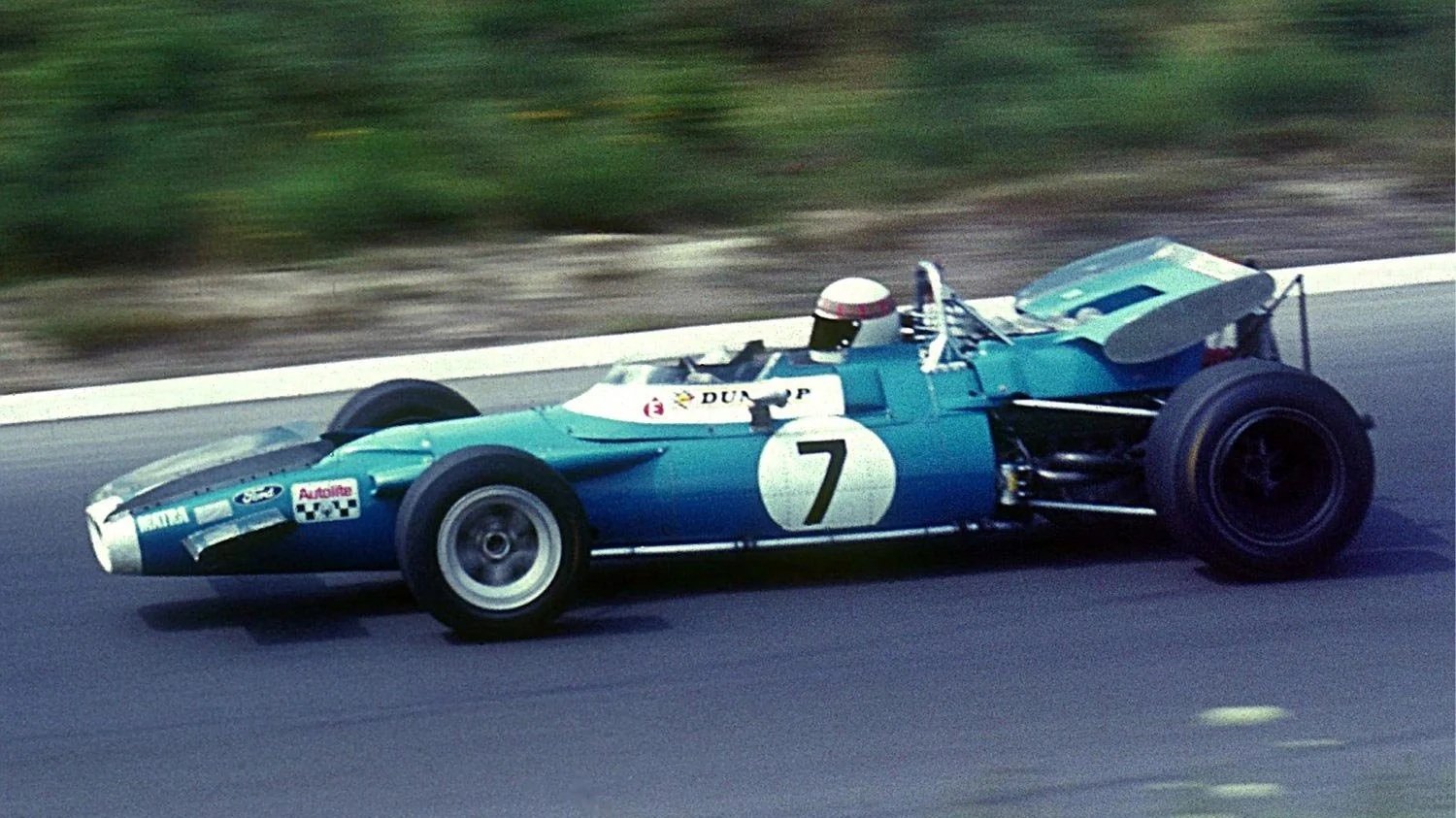
Jackie Stwart driving the Matra MS80 run by Ken Tyrrell in 1969.
Boyer described the MS80 as the MS10 “corrected,” and the corrections are telling. The MS10 had a lubrication problem in its suspension spherical bearings, so Matra equipped the MS80 with self-lubricating bearings. Understeer was addressed through weight distribution, moving the oil tank and widening the side tanks to keep fuel load rearward, creating the Coke bottle shape. Front wheels went from 15-inch to 13-inch rims to reduce unsprung mass, and rear brakes moved inboard.
Then Boyer lands on the point that Tyrrell people have always understood instinctively. “The key to the MS80’s success,” he said, “was that it was a good all-round performer, without necessarily being the best in any particular area.”
“The key to the MS80’s success was that it was a good all-round performer, without necessarily being the best in any particular area.”
That line is both technical and philosophical. It explains the car, and it explains why Tyrrell could win with it. Tyrrell’s competitive identity was never built on a single superpower. It was built on putting enough things in the right place at the right time, and refusing to waste energy chasing glamour.
Boyer’s broader formula for winning reads like a Tyrrell manifesto: “To win you need everything to be right: a good chassis, good engine, good tyres, good driver and good organisation.” In 1969, he said, Matra had all that.
The organisation part is where Tyrrell lived.
This is also where Matra’s aerospace story becomes more than a fun detail. Boyer explained that Matra’s aerospace experience influenced the car’s construction, particularly in the structural fuel tanks that were built with partitions, increasing torsional stiffness. Aerospace subcontractors used to precision light-metal construction helped build the car, and that accuracy mattered in preventing leakage from glued and riveted joints.
It is the kind of engineering detail that can feel abstract until you remember what 1969 Grand Prix racing demanded. Long races, heat, vibration, and the constant risk that small failures would become large ones. A car built with precision and stiffness is not just faster. It is kinder to its driver, clearer in its feedback, and less likely to turn a lead into smoke.
And then there was Stewart.
Goodwood describes Stewart in 1969 as “brimming with confidence” in his favourite F1 car, and notes that he won five of the first six races, then clinched the championship with victory at Monza. The phrasing matters. Confidence is not just a feeling. In the context of a late-1960s Grand Prix, it is survival instinct, mechanical sympathy, and the ability to control risk when the circuits were fast, the run-off minimal, and the sport’s safety standards still in the process of being dragged into modernity.
The 1969 season was only eleven races long. There was no room for a slow start, no room for wasted weekends. Stewart and Tyrrell did not waste them.
In that short calendar, dominance had a particular texture. It was not merely winning, but winning early enough that the rest of the field spent the summer chasing shadows. It was the quiet confidence of a pit crew that expects the car to start, the habits of engineers who arrive with answers rather than questions, and a driver who can sense when to push and when to protect. Tyrrell’s Matra did not feel like a fragile miracle. It felt repeatable, which is the most unsettling thing a small team can offer the giants around it.
Tyrrell’s role in that dominance is easy to miss because it is not photogenic. It is in the way a team arrives prepared. It is in the way weekends are planned, spares are ready, routines are rehearsed. It is in the way pressure does not cause panic. Motor Sport’s December 1969 profile, written while the title still had the shine of fresh metal, argues that Tyrrell’s success was built on judgement more than luck. The yard in Horsley was not a symbol. It was the operating reality behind a championship.
The sound of a future argument
This is where many histories end the chapter: the yard, the car, the title, the story of a private operator beating the establishment. Tyrrell’s story does not allow that neatness. Its triumphs always come with a built-in expiry date.
Matra had never intended to be a long-term Cosworth customer.
Motor Sport’s MS80 feature sets the context bluntly: Matra’s entry into motor racing was conceived partly to restore French pride, and that ambition could not be fully realised with an “Anglo-Saxon powerplant.” The Cosworth DFV was, for Matra, a bridge to its own engine, not a permanent choice.
That engine was the Matra V12, and it brought the first major divergence in the Matra-Tyrrell partnership. Boyer recalled that Stewart switched away because he would not race the Matra car with a Matra engine, and that Lagardère was determined they should use the V12, backed by government funding. This is no longer a purely racing problem. It is politics, identity, and financing entering the cockpit.
Goodwood’s Stewart account makes the moment vivid. Stewart tested the V12 and did not deny its theatre. “It sounded magnificent,” he said. “But it was larger and more complicated than the Cosworth and lacked its grunt. It was wasted power that you could hear.”
“It was wasted power that you could hear.”
It is a brutal phrase, because it is not merely an insult. It is a diagnosis. Stewart is describing a type of performance that is technically impressive but competitively inefficient. He is describing, in one sentence, the problem of doing motorsport for reasons other than winning.
For Tyrrell, this was the beginning of a new era. He had just won a world championship by being the best operator in the paddock. Now the partnership that made that possible was pulling apart, not in anger but in incentives.
Goodwood insists there was “no animosity.” That feels plausible. Tyrrell’s reputation was not built on melodrama. It was built on decision-making. When the incentives changed, the decision changed.
The wood-yard title had proved Tyrrell could win with the right ingredients. The next question was whether Tyrrell could win by making the ingredients himself.
Stewart remembered the pivot arriving as a simple question from Tyrrell. A question that, in the cold light of what it implied, was almost startling.
“What if I build you a car?”
