
Part 3: 1970–1973 A constructor is born.
A world championship should have bought Ken Tyrrell peace. Instead, it bought him a problem.
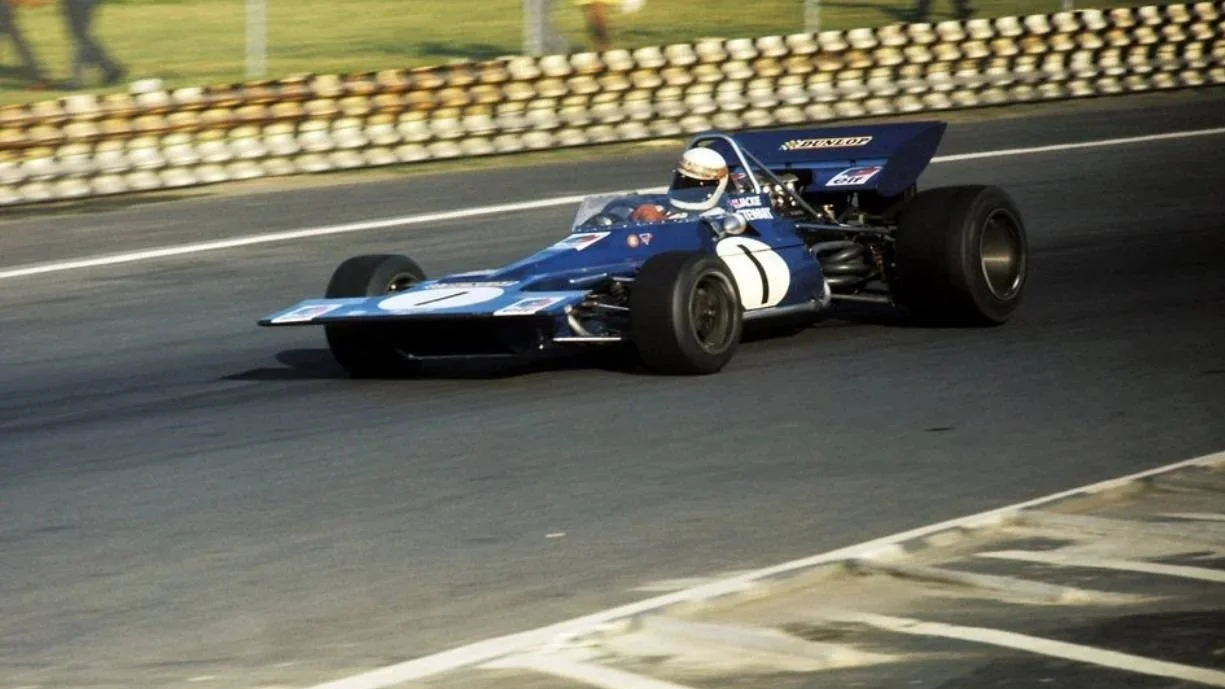
Jackie Stewart in the Tyrrell 001 at the Mexico Grand Prix 1970.
In 1969 he had done what every entrant dreams of and what most never touch: he ran a programme so sharply that, with Jackie Stewart and Matra, he conquered Formula One. Then Matra wanted to continue on different terms. The French manufacturer wanted the partnership, but it wanted it with its own V12, not the Cosworth DFV that Tyrrell trusted because it was fast, familiar, and equal. Stewart tried the V12. It sounded wonderful, he said, but it did not have the Cosworth’s bite.
It is easy, with hindsight, to turn that moment into a morality play about pride versus pragmatism. In practice it was a fork in the road. Tyrrell could either accept the engine that Matra believed it needed for identity and funding, or he could keep the engine he believed he needed to win and find a different chassis.
That second option came with a brutal catch. The established British constructors did not want to sell him a car.
“The problem,” Stewart said later, “is that established manufacturers wouldn’t sell to Ken.”
In one sentence the cosy, supposedly fraternal world of the garagistes becomes a market. Tyrrell had just dominated with the Matra. If you sold him a Lotus or a Brabham, you might be beaten by your own product, on the world stage, in front of your sponsors. So the champions of British ingenuity shut the door, and Tyrrell went shopping among the new.
March Engineering had just been launched and it would sell chassis to anyone with a cheque and the nerve. It was, Stewart said, “our only option.”
The arrangement that followed was supposed to be transitional, a single season spent using a customer chassis while Tyrrell figured out what came next. Instead it became a masterclass in why Tyrrell would have to become more than a brilliant entrant. It would have to become an author.
A customer car with sharp edges
The March 701, in 1970, was not a bad idea. It was light, elegant in its proportions, and it arrived at a moment when the DFV could still make anyone look clever. Motor Sport’s recent track test history of the 701 describes its debut as an immediate success, placing Stewart’s Tyrrell-run car on pole at Kyalami and on the podium at the first attempt, even if Dunlop’s tyres wilted in the South African heat.
Stewart won again in the spring, taking March’s first Formula One victory in the Race of Champions at Brands Hatch, then winning the Spanish Grand Prix at Jarama. It was the last time a privately-entered customer chassis would win a world championship Grand Prix, a small historical footnote that feels, in the Tyrrell story, like a warning shot.
The results were there. Tyrrell, as ever, could extract them. But the car did not feel like Tyrrell.
“Fundamentally the March wasn’t a bad design,” Stewart said, “but it was not a good car.”
The criticism was not about speed alone. It was about build quality, about confidence, about the subtle difference between something that can win and something you can live inside for a season. Stewart remembered components that felt as if they came from “the poorest quality road cars”, and he reached for an image that any British reader would understand: “something like a Hillman Imp.”
This is the sort of detail a high-end magazine piece should keep, because it tells you what Tyrrell valued. Not perfection, but integrity. Not glamour, but a car that felt properly made. Tyrrell’s whole identity, even then, was tied to a kind of seriousness. If something looked or felt cheap, it was a threat. Cheap parts cost races. Cheap habits cost lives.
The March season also sharpened Tyrrell’s sense that in Formula One you cannot outsource your future forever. Being dependent on another constructor’s priorities, production schedule, and tolerances is a weakness even when the results are decent. When the results are not, it becomes intolerable.
It is in this gap between competitive performance and personal dissatisfaction that Tyrrell began the most Tyrrell thing imaginable: he started building a car without telling anyone he was doing it.
The secret project
Motor Sport’s telling of Tyrrell’s first in-house Formula One car describes it as a “cloak-and-dagger affair”. The words are perhaps grander than the reality, which was less espionage and more old-fashioned loyalty. But the secrecy mattered. A small team could not afford to announce its ambition early and become the paddock’s entertainment. It needed to arrive with something real.
Neil Davis, one of Tyrrell’s trusted men, remembered the origin story beginning not in a boardroom but in the front seat of a car on the way into Guildford. He told Tyrrell, “These Marches we’re running are heaps of rubbish. Why don’t we build our own car?” Tyrrell replied that he had been thinking along those lines.
“These Marches we’re running are heaps of rubbish.”
The phrase is blunt, almost comic. It also captures the practical, unsentimental culture Tyrrell had built. Problems were named. Solutions were pursued. Complaints were only useful if they became action.
Only a handful of people knew. Davis said that beyond Tyrrell, his wife Norah, designer Derek Gardner, and Stewart, nobody else was told. Stewart’s own recollection, separately, supports the shape of that secrecy. Tyrrell was cautious, he said, and did not tell people even when the decision was made.
Gardner was an inspired choice. Not a star designer in the public imagination, not a man with a name that would impress sponsors at a dinner. A meticulous engineer with the temperament to do the work properly, even when the schedule was brutal.
Davis described Gardner being brought on with a handshake in a pub in Twyford. “No contracts or any of that,” he said. “His word was always his bond.”
“No contracts or any of that. His word was always his bond.”
That is not how modern Formula One works. It is barely how modern life works. But it tells you what Tyrrell was trading in at the time. Trust, loyalty, and speed. Contracts slow you down. Lawyers make you cautious. Tyrrell, at that moment, needed momentum.
In Stewart’s memory, the first time he “laid hands” on the project was at Gardner’s house near Leamington. Inside the attached garage was a wooden mock-up. He was asked to check the seating position.
The image repeats itself in multiple accounts because it is irresistible: the seed of a world championship team taking shape not in a factory, but in a suburban garage. Goodwood’s Stewart feature describes it as a full-scale wooden monocoque mock-up, the kind of thorough preparation Stewart said he had rarely seen. Motor Sport’s retrospective on the secret project reinforces the same point, and makes the case that the mock-up was unusually complete for a first-time Formula One designer.
This is the Tyrrell pattern becoming visible again. If you cannot buy your way into the future, you build your way into it. If you cannot announce the plan, you work quietly until you can.
The first Tyrrell Formula One car, the 001, was assembled in the old army shed at the timber yard, with Davis remembering eight people completing the job. The romantic reading is “garagistes versus giants”. The more accurate reading is “small team, brutally efficient, making its own luck”.
And then, because Tyrrell never had the luxury of gentle timelines, the car had to be seen by the right people, at the right moment, for the right reasons.
Derek Gardner told Motor Sport that the deadline was the Oulton Park Gold Cup in August 1970, an unofficial closing date for sponsorship decisions for the following season. “We could not afford to miss that race,” he said.
“We could not afford to miss that race.”
That one line explains a great deal about how Tyrrell worked. It was not simply building a car for the joy of it. It was building a car to keep the project alive. The car was a pitch, a proof, a bargaining chip. It had to appear, it had to look serious, and it had to be fast enough to make people believe.
Oulton Park and the first evidence
The 001’s debut at Oulton Park was messy, as first races usually are, but it had the most persuasive quality a new machine can show: pace. Stewart’s recollection of that first run in the new car is unusually immediate. Tyrrell had negotiated exclusive track time before the race, and Stewart said he could tell straight away the car was “a big step forward”.
It was, he also admitted, nervous. Gardner favoured a short wheelbase, and that made the car “extremely nervous at some circuits.” But nervousness is a manageable flaw if it comes with speed. Stewart recalled that once early troubles cleared, the car’s potential was obvious, not least because he took two seconds off the lap record he had set in the Matra a year earlier.
Motor Sport quoted Denis Jenkinson’s report of the event, praising the way Stewart drove the new car with an “artistry” that had been missing with the March. That is a useful detail, not because it flatters Stewart, but because it suggests the car was already giving him something the March could not: trust.
The 001 then appeared at the end of the 1970 championship season and promptly did what promising Tyrrell machinery often did in its earliest forms: it led, and it broke. In Canada, Stewart took pole and led comfortably until a stub axle failed. At Watkins Glen, he led again, this time for most of the race, until an oil line worked loose.
For Tyrrell, those failures were frustrating. For a sponsor, they were proof. A team that can build a car in secrecy, arrive late, and still put it on pole has something. Reliability is expensive, but it is solvable. Pace is rarer.
The move from entrant to constructor was no longer theoretical. It was happening.
Montjuïc and the first Tyrrell win
The transition from making a car to winning in it can take seasons. Tyrrell compressed it into months.
In April 1971, in Barcelona’s Montjuïc Park, Stewart won the Spanish Grand Prix and delivered the first Formula One victory for a Tyrrell-built car. Motor Sport’s anniversary feature on that race calls it hard-fought and “won with precision and determination,” a fitting first victory.
The circuit itself mattered. Montjuïc was spectacular and slightly mad, a public park turned into a high-speed test of bravery and restraint. Stewart remembered it as one of the great circuits, with slow corners, fast corners, long straights, and violent changes in altitude.
The race was also a clean representation of Tyrrell’s culture. It was not a victory built on chaos. It was built on control.
When Motor Sport’s writer asked Stewart whether it was a blast to drive, he answered “No,” and then explained why. “I removed emotion,” he said. “You learn how to be clinical.”
“I removed emotion. If you got emotional you made a mistake.”
That line could be engraved on a plaque outside the Tyrrell shed. It captures the difference between raw speed and professional speed. Tyrrell’s best years were built on drivers and engineers who could separate feeling from function.
It also captures Stewart’s particular sophistication. Many great drivers describe themselves as fearless. Stewart described himself as disciplined. The more relaxed you became, he said, the faster you went.
Then he described the Tyrrell reaction to winning, and it was almost absurd in its lack of theatre.
“There was no celebration,” Stewart said. Tyrrell would clap once, rub his hands, and then start delegating: “Right, you get this box done you get that box done so let’s get home.”
“There was no celebration.”
It is a wonderful detail because it is funny, but it is also revealing. Tyrrell did not treat winning as an endpoint. He treated it as confirmation that the work was worth doing. Then he went back to the work.
A champion built in a wooden hut
By the end of 1971, the Tyrrell story had changed from “clever entrant” to “world champion constructor”. In his first full year as a constructor, Motor Sport’s season database notes, Tyrrell gave Stewart a car that was quick and reliable. Stewart delivered six wins and the title, a dominance that the database likens to Jim Clark.
Stewart’s own recollection of that season carries a different emphasis. It was special, he said, because it was Tyrrell’s first full season as “a manufacturer.” Not a supplier, not a customer, not an operator. A maker.
The language matters. “Manufacturer” suggests scale. Tyrrell did not have scale. Tyrrell had method. Stewart’s quote that follows is one of the most valuable in the entire Tyrrell canon because it captures what Tyrrell represented at the time.
“It wasn’t like Mercedes-Benz, Auto Union or Alfa Romeo coming in,” he said. It was a “very competitive period” and they ran from “this little wooden shed.” Tyrrell was, as Stewart noted, “really a timber merchant.”
You do not have to romanticise that image. It already contains the romance, and the defiance.
This is also where it is worth being precise about what Tyrrell’s smallness meant. It did not mean amateurishness. Stewart recalled that they ran two cars with seven mechanics. That is not quaint, it is a workload that would terrify a modern team manager. Tyrrell’s competitive advantage was concentration. Fewer people meant fewer places for confusion to hide. It also meant everyone had to be good.
Stewart credited Tyrrell not only for choosing the right people, but for how he treated them.
“One of Ken’s great skills,” he said, was “choosing the right people and knowing how to look after them.” He organised life and medical insurance, Stewart noted, and no other team did that in those days.
“Ken chose the right people and knew how to look after them.”
This is a quieter kind of leadership, but it is the kind that wins championships. A small team can beat big teams if it can keep its best people loyal and focused. Tyrrell’s shed was not only a physical location. It was an operating philosophy. Look after your people. Remove nonsense. Concentrate on performance.
Cevert, the heir apparent
The Tyrrell story in the early seventies is often told as a duet: Stewart the champion and Tyrrell the organiser. But to end Part 2 in a way that feels true, you need to bring François Cevert into focus as more than a supporting character.
Cevert was not simply Stewart’s number two. He was the future Tyrrell was building toward, a fast Frenchman with charm and steel, a driver who could win in his own right and also carry the team into the post-Stewart era. He proved it with his 1971 United States Grand Prix victory at Watkins Glen, and by finishing third in the 1971 championship.
By 1973, Tyrrell was again at the front, in a classic contest with Lotus. Motor Sport’s 1973 season database notes Stewart taking his third title in his final year, and then points to the tragedy that ended the season: Cevert, “groomed to replace Stewart,” killed in practice for the United States Grand Prix.
Motor Sport’s contemporary 1973 obituary is clinical and devastating in its simplicity: “What was a great season for the Elf Team Tyrrell organisation came to an unhappy end at Watkins Glen when their talented French number two driver Francois Cevert was killed in a practice accident.”
It adds a detail that matters to Tyrrell’s narrative arc. Cevert had proved his worth by taking six second places during 1973. Second places are not consolation in that era, they are strategic. They are how constructors’ titles are won. They are the quiet proof of a driver who can be relied upon.
And then there is Stewart’s version of that final weekend, told with the calm of a man who has spent decades carrying it.
Tyrrell withdrew from the race, Stewart said, not out of fear but out of respect. “It would have been wrong for me to go and drive a racing car the day after one of my best friends had been killed.”
He also revealed a detail that turns the story from tragedy into something almost cruelly intimate. On the Friday evening, Tyrrell had suggested that if they were running first and second, it would be a nice touch for Stewart to pull over and let Cevert win. Stewart said he would think about it. It would have been his 100th championship Grand Prix start, and his last. The decision, he said, became one he did not have to make.
“It would have been wrong for me to go and drive a racing car the day after one of my best friends had been killed.”
In another paragraph, Stewart explained that he had known since April that he would retire. He had told only Tyrrell and Walter Hayes from Ford, and he had not yet told his wife. Cevert did not know. He would never know that he was about to be promoted to team leader.
There is no need to over-write that. It is already heavy enough.
Part 2 begins with Tyrrell being forced into authorship by politics and circumstance. It ends with Tyrrell’s authorship producing the most complete proof imaginable, a constructors’ championship in the first full year of building his own cars, then another drivers’ title in 1973, and a future successor ready to inherit the team.
And then the sport takes the successor away.
If Part 1 was the timber yard proving it could win with the right ingredients, Part 2 is the timber yard proving it could make the ingredients, and then learning what it costs when the human pieces of the machine are the ones that break.
