
Part 1: 1960s -1967 The Shed Before the Shed
Walk into the Tyrrell shed today and the romance is immediate. The timber walls are close enough to feel like a constraint. The light has that workshop quality, part natural, part practical. Nothing about it says “world champion” until you remember that is exactly what it produced, and that Goodwood’s restorers made a deliberate choice not to sand the story out of it. “We’ve tried not to refurbish it and have kept its bumps and bruises intact,” said circuit manager Sam Medcraft when the building arrived at its new home.
The temptation is to treat the shed as a punchline, a quaint relic from an age before wind tunnels and campus-sized factories. That misses what Ken Tyrrell understood before most of his rivals did. The shed was never the point. The point was the work, and the type of people you can persuade to do it in a place like this.
Before Tyrrell became a constructor, before it became a champion, it became a finishing school.
In the early 1960s, Ken Tyrrell’s name was not yet a decal on a Grand Prix car. It was the name on the entry forms of a junior single-seater programme that behaved like a serious organisation long before it had any business doing so. Tyrrell had raced himself, enough to learn his limits, and then stepped aside with the clarity of a man who can hear the truth even when it hurts. He stopped driving in 1959 and began running a Formula Junior operation from the family’s timber business woodshed, building a team out of a place that was never meant to be a team’s home.
By 1960, his relationship with Cooper had deepened into something formal: the Tyrrell Racing Organisation was established to run the factory Cooper-BMC team in Formula Junior, based at his timber yard. And by 1961, the operation had expanded again to include Mini Coopers.
Those details matter because they hint at Tyrrell’s competitive advantage long before Formula One ever came into the frame. He was not simply running cars. He was running systems. He was learning how to manage people, parts, deadlines, and reputations, the same raw materials that later decide championships.
Formula Junior was supposed to be the entry level of single-seater racing, but in that period it was also a proving ground for the sport’s future DNA: engines that forced ingenuity, grids stacked with talent, and teams that learned to win with discipline rather than budget. Tyrrell’s version of it was unusually hard-headed. He was not building a clubman’s hobby. He was building a pipeline.
The Cooper twins and Tyrrell’s taste for seriousness
It is difficult now to convey how much of motor racing once ran on trust and reputation, how much was done on handshakes and word-of-mouth, and how much a team’s credibility lived in the time it arrived at the circuit, the spares it brought, and the calm it carried into a long day.
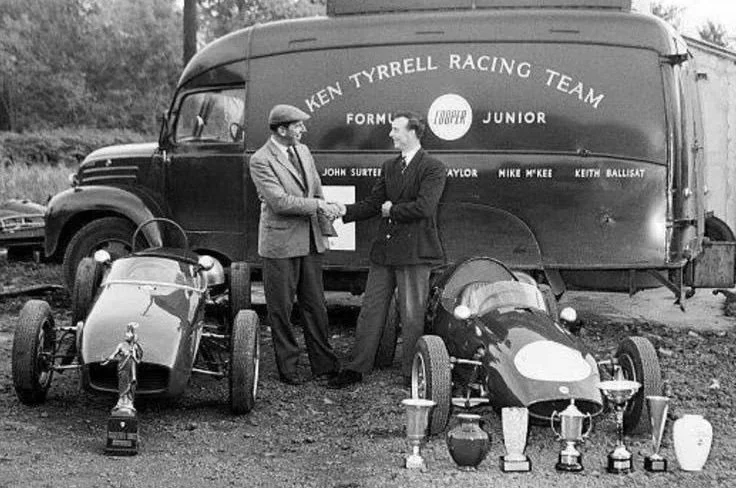
Tyrrell’s Formula Junior programme drew serious drivers, and serious results.
One of the most vivid period threads is the Cooper-BMC works effort in 1961, run by Tyrrell, with John Love and Tony Maggs sharing the work and, frequently, the success. The Formula Junior historic register records that the Cooper works team cars were run by Tyrrell and raced by Love and Maggs in 1961, with the pair “hugely successful” across European races. Maggs’s own biography notes he was part of Tyrrell’s Cooper-BMC Formula Junior team in 1961 and shared the European title with Jo Siffert. It is easy to reduce this era to names and results.
The more interesting story is what Tyrrell was building behind those wins: a way of working. Formula Junior demanded mechanical sympathy and a ruthless intolerance for wasted effort. You won by making sure the car ran properly, by keeping the driver confident, and by avoiding the slow death of small mistakes. Tyrrell’s later Formula One identity, the calm organisation, the insistence on doing things properly even in modest surroundings, can be traced straight back to those junior paddocks.
There is also an early hint of Tyrrell’s talent for spotting something that was about to matter. Multiple sources describe Tyrrell as giving single-seater opportunities to future greats, including John Surtees and Jacky Ickx. The details of “firsts” are often messy in racing history, but the pattern is clear enough to be meaningful: Tyrrell’s operation became a place where a driver could be taken seriously early, and treated as if they belonged.
That treatment is not sentimental. It is strategic. Drivers rise faster when a team behaves like their future depends on them, because it often does.
A young Scot walks into the story
By the early 1960s, Tyrrell had another problem to solve: how to find the next driver before the rest of the paddock noticed them, and how to test their temperament as much as their speed.
Jackie Stewart’s entrance into Tyrrell’s orbit is one of those moments that has been told so often it risks becoming myth. The reason it survives repetition is that it contains something true about the era, and about Tyrrell himself: performance could still change a life in an afternoon.
Motor Sport’s database biography of Stewart describes him racing Tyrrell’s works-backed Cooper T72-BMC in Formula 3 after impressing during a test at Goodwood. Stewart won his debut at Snetterton, and the margin was so large it reads like a typo: 44 seconds clear of second place.
In Motor Sport’s December 2011 reflection on Stewart and Tyrrell, Stewart remembers that same Goodwood test with the kind of detail that survives because it hurt to forget it. Bruce McLaren was there and set a time. Stewart beat it. McLaren went out again to respond. Stewart beat it again. John Cooper was watching from Madgwick corner, and afterwards, Stewart heard him say to Tyrrell: “You’ve got to sign him!”
“You’ve got to sign him!”
That is the origin moment, but the larger truth is what came next. Stewart did not merely win races for Tyrrell. He dominated. In Tyrrell’s Cooper, Stewart won the BARC F3 title, the Monaco Grand Prix support race, and the French Grand Prix curtain-raiser at Rouen. It was the kind of season that forces a young driver into the next room, whether he is ready or not.
Tyrrell’s role in it is often described as talent spotting. That is too passive a phrase. Talent spotting implies you look, you recognise, you sign. Tyrrell’s gift was building an environment where a young driver could become dangerous quickly, not only through speed, but through clarity.
In Stewart’s own telling, the partnership was always built on something more than pace. It was built on belief and method, and on Tyrrell’s willingness to take the kind of risk that feels reckless only if you do not understand why it was necessary.
The apprenticeship continues, even as Stewart leaves
Stewart’s Formula One career did not begin with Tyrrell. He was invited to BRM after his overwhelming F3 season. In 1965 he joined BRM and, in Stewart’s first season there, won a Grand Prix at Monza. The public story is that Tyrrell discovered Stewart and then lost him to a bigger stage.
The private story is more interesting. Stewart continued to drive for Tyrrell in Formula Two even while he raced Formula One for BRM, and Tyrrell’s programme moved up with him. Tyrrell ran BRM-linked machinery in Formula Two and then moved into Matra’s orbit.
This is where Tyrrell’s shed becomes something more than a workshop. It becomes a base of operations that can support a driver across categories, and it becomes a node in a network of manufacturers and suppliers.
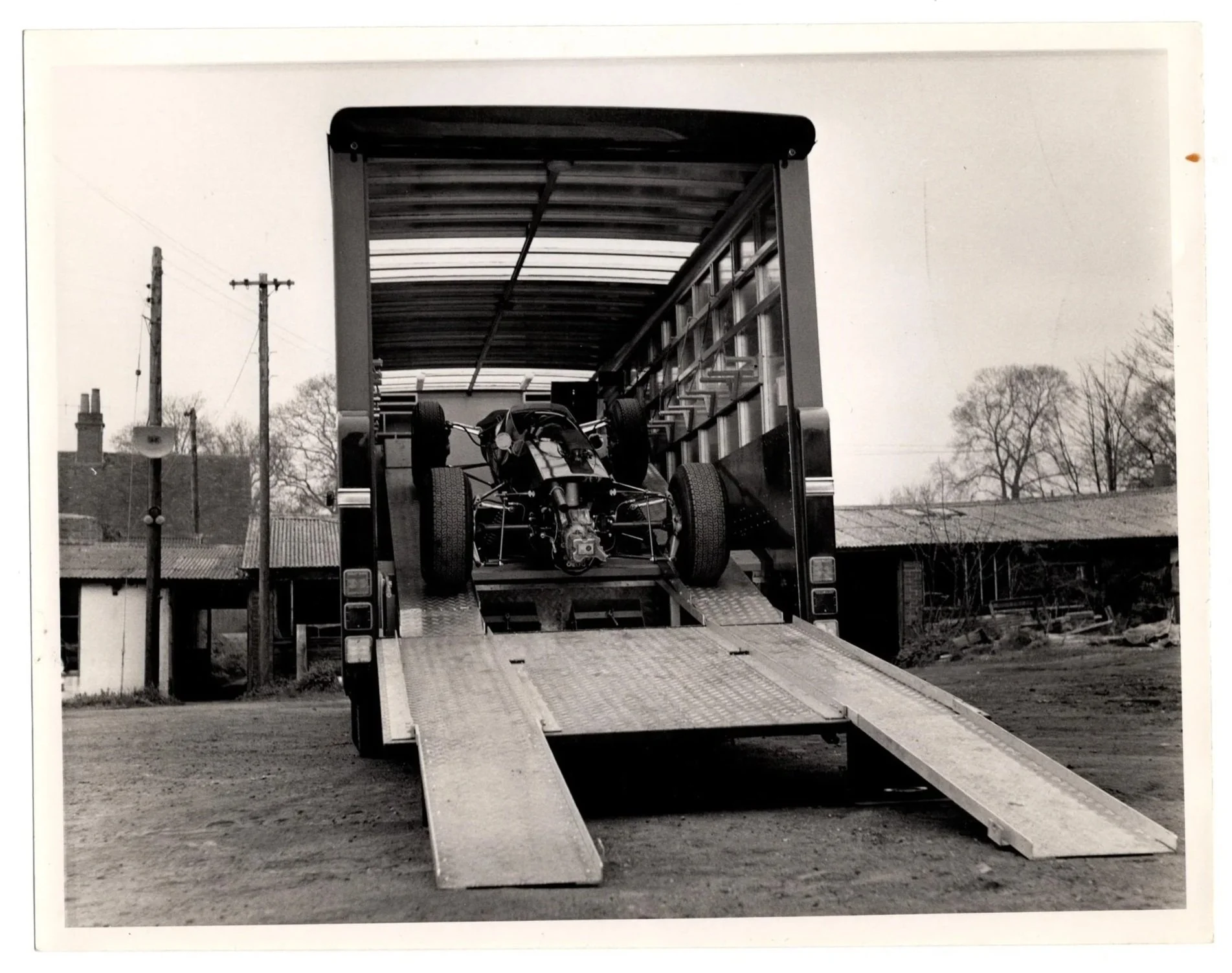
In February 1968, Motor Sport wrote that throughout 1967 Matra had three strong single-seater teams: the factory F2 cars, the factory supported F2 cars “of Ken Tyrrell” driven by Stewart and Ickx, and the factory F3 team. The phrasing is revealing. Tyrrell is no longer an outsider hoping for attention. He is an officially supported strand of a manufacturer’s programme, because he can deliver results and because his operational standards make him a safe pair of hands.
This period also introduces another Tyrrell trait that would define his later Formula One years: he built relationships with people who could open doors, and he did it with a mixture of persuasion and credibility rather than noise.
The man Tyrrell becomes in Formula One, the one who can talk to sponsors, manufacturers, and Ford, was forged here, in the years when he had to make a junior team feel like a serious one to keep it alive.
Ickx, the Nürburgring, and Tyrrell’s first brush with the Grand Prix world
Jacky Ickx’s early relationship with Tyrrell tends to be compressed into a few lines, but it is worth dwelling on it, because it shows Tyrrell’s appetite for making bold moves with young drivers before the paddock had agreed they were “ready.”
Tyrrell’s first entry into a World Championship Grand Prix came at the 1966 German Grand Prix, where he entered Formula Two-spec Matras for Ickx and Hubert Hahne. Ickx was involved in a first-lap crash, a grim reminder of the era’s cost. The following year, Tyrrell entered Ickx again at the Nürburgring in an F2 Matra. Ickx qualified with the third-fastest time, though F2 cars were required to start at the back. He ran as high as fifth before retiring with broken suspension.
That is not just trivia. It is a snapshot of Tyrrell’s method. Use the best young drivers. Put them in strong machinery. Turn up to the most brutal circuit in the calendar and behave as if you belong. Take the publicity if it comes, but focus on the work.
It also demonstrates the other side of Tyrrell’s character: he could be ambitious without being theatrical. He did not need to announce himself. He needed to appear, perform, and leave the paddock with people talking.
The offer, the retainer, and the shape of 1968
By 1967, Stewart’s Formula One season with BRM had become “pretty barren,” as he later put it. He began to look elsewhere. He even went as far as a handshake with Enzo Ferrari, then walked away when he felt the team had mishandled its promises. In a different timeline, the Tyrrell story never becomes what we know, because Stewart ends up in red.
Instead, Tyrrell made a plan.
It was not yet the fully formed “Matra International” programme that would later dominate. It was still, in Stewart’s words, a plan. But it was a plan with a direction: Formula One, Matra chassis, Cosworth power. There was a problem, as there always was with Tyrrell. Money.
Stewart recalls telling Tyrrell he could not afford him. The retainer he had in mind was the same Ferrari had offered: £20,000. Tyrrell got the money from Walter Hayes of Ford. “Suddenly the game was afoot,” Stewart said.
And then Stewart drops the detail that tells you almost everything about the nature of this partnership. For the remainder of his Formula One career, driving Matra, March and finally Tyrrell chassis, he drove only for Ken Tyrrell, and he did so without a contract.
For the remainder of his Formula One career, driving Matra, March and finally Tyrrell chassis, he drove only for Ken Tyrrell, and he did so without a contract.
That is not a quaint anecdote. It is the foundation of what Tyrrell became. The great Tyrrell years were built on trust, on directness, and on a shared willingness to be clinical about what mattered. Stewart trusted Tyrrell’s judgement. Tyrrell trusted Stewart’s discipline and feedback. Both trusted that the work would be done properly, even in small rooms.
When Goodwood describes Tyrrell establishing his racing team in 1958 in an ex-military issue shed in the yard of his family’s timber business, it is describing the physical setting of that trust. Motor Sport adds the practical detail that the shed was originally a military building moved to the site in 1950, and that it later faced demolition before its rescue and relocation.
The building survives because people understand what it represents. Not nostalgia, not quaintness, but the idea that a serious organisation can be built almost anywhere if the standards are high enough.
That is the true beginning of Tyrrell’s Formula One story, and it happens before the first Grand Prix entry form, before the first Elf-blue livery, before the first championship.
It begins when a timber merchant decides that the easiest way to secure a future is to manufacture it, first in Formula Junior, then in Formula 3, then in Formula Two, and finally, inevitably, on the world stage.
