
Loïc Depailler takes the wheel as the P34 returns to Paul Ricard
Fifty years after Patrick Depailler raced the Tyrrell P34 at Paul Ricard, his son Loïc took to the wheel of a six-wheeled Tyrrell at the Grand Prix de France Historique. What might have been a rare anniversary appearance became something more exact: a car, a circuit and a family name reconnected in motion.
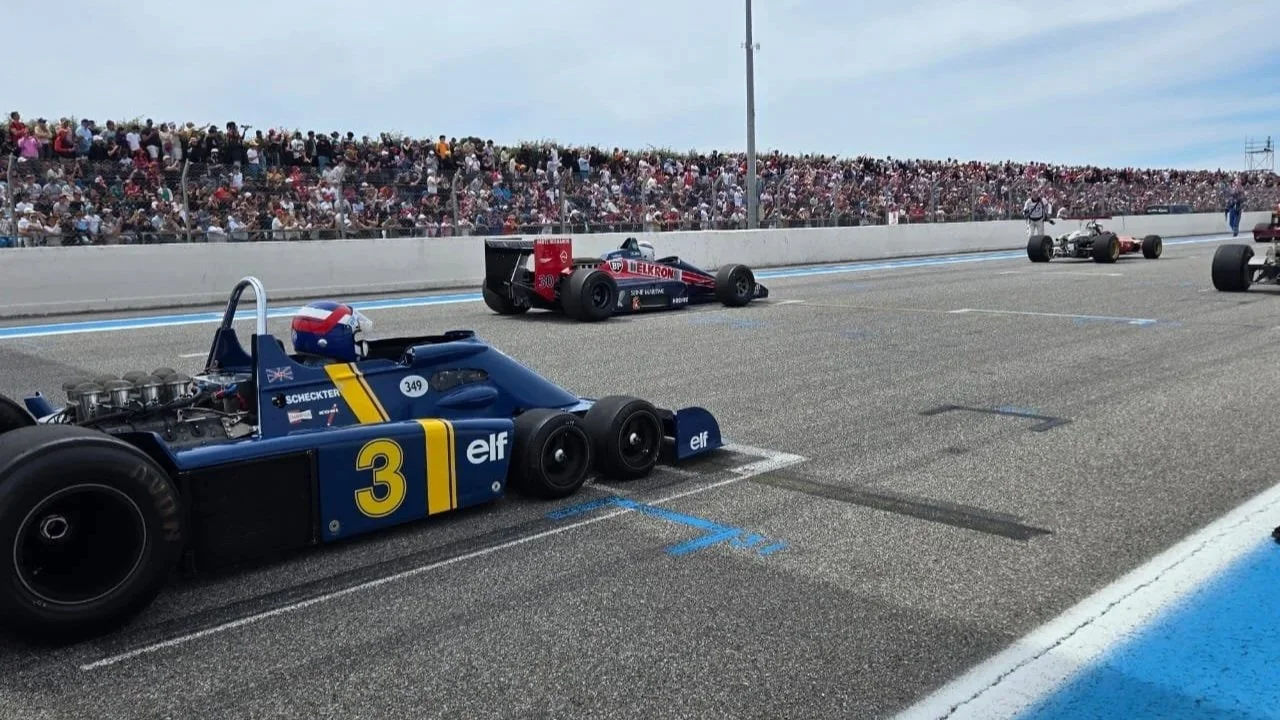
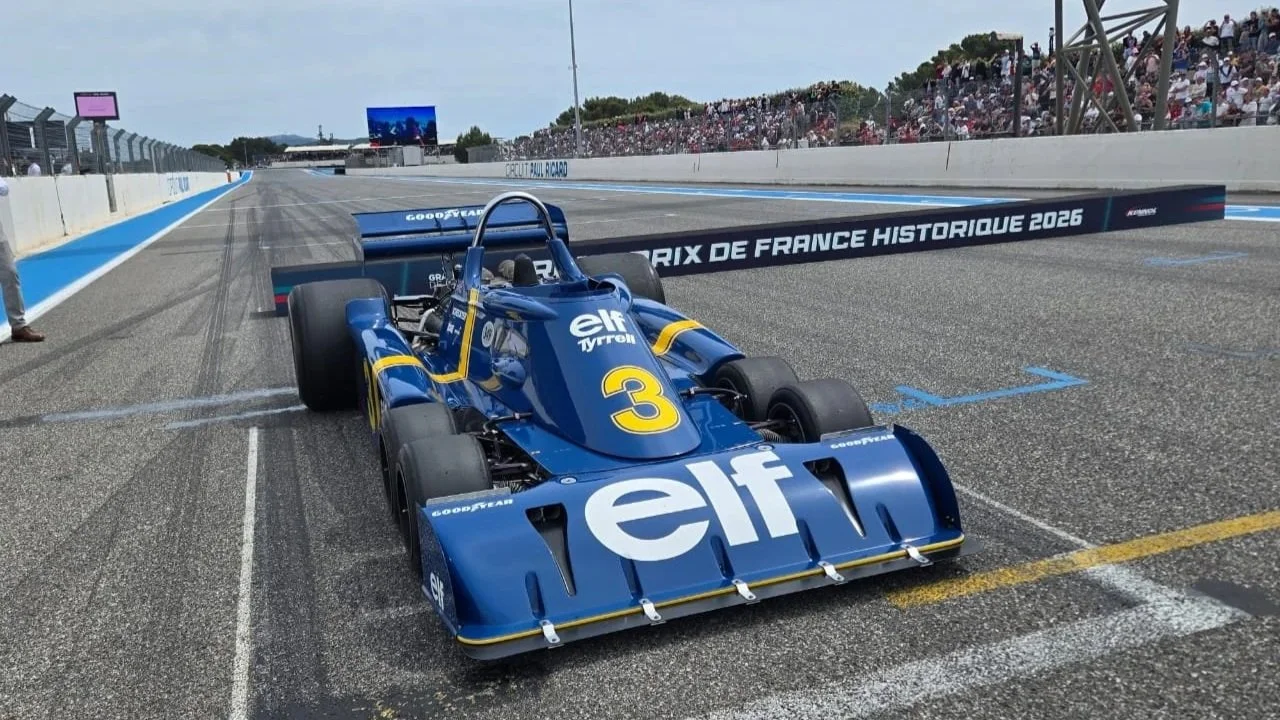
There are cars that need explanation before they make sense. The Tyrrell P34 is not one of them.
It explains itself immediately. Four small front wheels tucked beneath the bodywork. Two conventional rears. The familiar blue and yellow Elf Team Tyrrell colours. A shape that still looks like a decision rather than a design exercise.
But this time, the name mattered as much as the layout.
At the 2026 Grand Prix de France Historique, Loïc Depailler drove the six-wheeled Tyrrell at the circuit where, fifty years earlier, his father Patrick finished second in the 1976 French Grand Prix. It turned the P34’s anniversary appearance into something more than a display. The car was back on a French circuit, in front of a French crowd, carrying a French driver’s story forward through the next generation.
The P34 has often been reduced to its wheel count, as if Derek Gardner’s design was an act of theatre. Tyrrell knew otherwise. The point was not to shock the paddock. The point was to solve a problem: reduce the drag of exposed front tyres, increase the front contact patch and find a different route to grip.
Patrick Depailler was central to giving that idea credibility in period. At Paul Ricard in 1976, the P34 was not a curiosity. It was on the podium.
Fifty years on, with Loïc Depailler at the wheel, the car’s return carried a different force. Not sentiment for its own sake. Continuity. The kind that only happens when a machine is started, warmed, driven and trusted again.
France was part of the P34 story almost immediately.
The Depailler connection gives the Paul Ricard appearance its proper weight. Patrick was not a passing name in the P34 story. He raced it, developed it and helped make the idea visible as a serious Grand Prix car. On 4 July 1976, he finished second at Paul Ricard in a Tyrrell P34, behind James Hunt, with Jody Scheckter sixth in the sister car. For a French crowd, a French sponsor and a French driver, the shape was not only unusual. It was competitive, visible and close to home.
For Loïc to drive a P34 at the same circuit in 2026 is not a neat anniversary flourish. It is a working line between two moments: one in the middle of Tyrrell’s most radical Formula 1 experiment, the other in a historic racing paddock where that experiment still makes sense when the engine is running.
That connection was felt again at the 2026 Grand Prix de France Historique. The event has become one of the rare European stages where historic Formula 1 machinery is not only displayed, but exercised with purpose. Across the weekend, Circuit Paul Ricard hosted period single-seaters, Masters Racing Legends, Formula 2 and Formula 3 machinery, prototypes, GTs, Group C cars and demonstration runs. In that company, the P34 did not feel like an eccentric interruption. It felt like it belonged to the argument.
That connection was felt again at the 2026 Grand Prix de France Historique. The event has become one of the rare European stages where historic Formula 1 machinery is not only displayed, but exercised with purpose. Across the weekend, Circuit Paul Ricard hosted period single-seaters, Masters Racing Legends, Formula 2 and Formula 3 machinery, prototypes, GTs, Group C cars and demonstration runs. In that company, the P34 did not feel like an eccentric interruption. It felt like it belonged to the argument.
The P34 was always an argument. Not a gimmick. Not a stunt. An argument for independent engineering judgement.
Tyrrell’s best ideas were rarely decorative. They came from constraints: common engines, common gearboxes, regulations that left narrow openings, and a team prepared to look at those openings differently. The P34 was the most visible expression of that habit. It was also one of the most exposed. A good idea in Formula 1 is only as strong as the system around it, and the P34’s dependence on bespoke small front tyres made its long-term future fragile. As tyre development moved elsewhere, the advantage narrowed. By 1978, Tyrrell had returned to four wheels.
That is not failure. It is the price of trying something real.
Engineering courage is not the same as novelty.
At Paul Ricard, fifty years on, the car still carries that lesson cleanly. Originality only matters if it is pointed at a problem. Gardner’s six-wheeler was pointed at a problem with unusual clarity, and Tyrrell backed it far enough for the idea to win.
The sight of a P34 on the Paul Ricard straight in 2026 does not ask for nostalgia. It asks for proper attention. To the portholes cut so the driver could see the front tyres. To the front wing and brake ducts. To the four small contact patches that made everyone look twice. To the people who believed the sport still had room for a smaller team to think against the grain.
For Team Tyrrell, that is the value of seeing cars like this run. History is strongest when it is put under load. A car has to start. It has to steer. It has to stop. It has to carry its story through a corner, not merely sit beside a caption.
The P34 still does that.
